

... But Everyone Can Do Something
Chapter 2 | Too Tired to Change

I’m serializing my debut nonfiction book on Substack—for FREE! You can start by reading the introduction right here. We need more Christian books by authors who are focusing on presence rather than platform and craft rather than celebrity. So, I’m raising money to fund a new micropress called Beautiful Discipleship Books. Support us by becoming a free or paid subscriber and contribute to a publisher where our witness is the Word.
The socks were my signature. Rainbow stripes or tiny, cute bows woven onto a bright background. Always knee length, and always colorful.
To compete in homeschool speech and debate tournaments boys and girls from 12 to 18 years old were required to wear full business attire. The ties were the thorns in the sides of the young men, while the girls’ wardrobe woes always involved our pantyhose. We weren’t allowed to have bare legs beneath our skirt suits and shift dresses, but we were also kids who didn’t want to sit stiffly in between debate rounds, so our tights were constantly ripping and running in unprofessional fashion. The socks were my solution.
After completing a ten-minute persuasive speech before a panel of three judges I would walk across the college campus that was hosting the tournament to the quad where the parents had set up lawn chairs and folding canopies. This is where we would hang out with our peers, parents, and coaches between rounds. With a sigh of relief I would tug my pinched feet one at a time out of my kitten heels and pull on knee high socks over my fragile pantyhose, carefully balancing on one foot, and then the other so I wouldn’t touch the grass. If I needed to walk to the parking lot to retrieve snacks from the car or visit the restroom in the student center I would slide into comfortable clogs and be on my way. I reveled in my short window of comfort before room assignments were posted for the next round when heels would be re-donned, lapels straightened, and deep breaths taken before we plunged back into argument and persuasion.
The Joshua Generation
Competitive speech and debate was just one spoke in a wheel that wore deep tracks over the course of my adolescence, training me for a mission of achievement and accomplishment and advocacy for the cause of Christ. Other spokes of that wheel included worldview summer camps, civics courses, and instruction in political engagement. Alongside my peers, I was being discipled into a specific story, prepared to play a role that placed me, not in the wings, and certainly not in the awed audience, but at center stage, squarely in the center of that bright spotlight labeled World Changer.
While it’s likely foolish to credit the creation of this wheel to one person or organization, much of the religious right’s zeal for political activism can be traced back to the founding of The Moral Majority in 1979 by Jerry Falwell, Sr. The organization, though only in existence for ten years, critically shifted the emphasis of evangelical engagement in society from preaching the gospel to political advocacy, specifically in conservative, Republican spaces. At the same time that Christian conservatives were growing concerned with the secularization of America’s public schools, home education emerged as a compelling alternative for parents who wanted to ensure their children’s education was grounded in biblical principles. Michael Farris, a young lawyer and The Moral Majority’s state director in Washington would become one of the most influential leaders of the fledgling homeschool movement, founding the Homeschool Legal Defense Association (HSLDA) and securing legal protections for home educators in all 50 states by 1993.
In 1997, the HSLDA pioneered the National Christian Forensic and Communication Association (NCFCA). Their mission was to train “poised speakers, curious researchers, and resilient advocates for a biblical worldview.” Today, their website boasts 3,000 students competing in speech and debate tournaments across the country. The speech and debate league for which I competed in high school was founded by a father in my local speech club as an alternative to the NCFCA in 2009.1 Their website proudly states their mission: “To develop world-class communicators who speak boldly and change the world for Christ.”
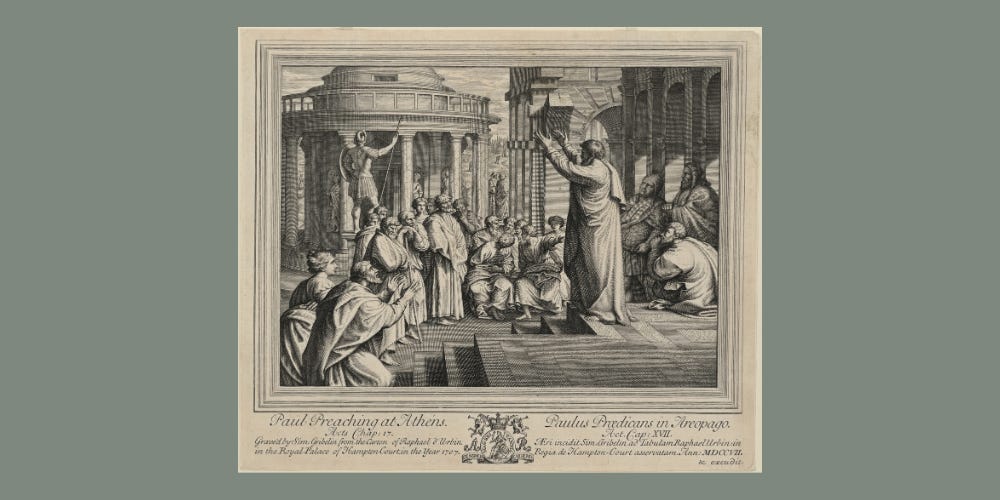
I recall being present for some of the first discussions of this new league, and my coach, an emergency room physician and involved homeschool father who would go on to serve as Stoa’s second president, explained the meaning of our name. Stoa derives from a Greek word that refers to an ancient place of gathering and discussion. They believed the Apostle Paul’s speech at the Areopagus in Acts 17 would have happened in a stoa. Like Paul, our objective was to study and train so that we could convince the culture around us of the truth of our biblical worldview.
In addition to developing rhetorical skills, political campaigning and community organizing became key spokes in this wheel of progress as it charted its groove of world change. So, Michael Farris also started an initiative within the HSLDA in 2003 called Generation Joshua.2 “GenJ”, as its young members referred to it, facilitated youth participation in politics, civics, and government, primarily by campaigning and canvassing for GOP politicians in contested state and national races and organizing voter registration drives.3 Farris believed homeschool teenagers could become one of the most powerful forces in American politics, eventually overturning Roe v. Wade and the legalization of same-sex marriage as they worked together to take back the promised land.4
Together, the youth of these decades, gathered in church basements and Sunday School classrooms around the country to debate conservative policy positions and hone our powers of persuasion and apologetics arguments came to be known as the Joshua generation. Like the Torah Israelites, we were poised on the edge of the Jordan, ready to recover the promised land with a shout of victory. But unlike the children of Abraham, we believed our success depended on a lot more than praising God and a few symbolic laps around Jericho’s walls.

Political Means For Kingdom Ends
It had been half a dozen years since I had worn a suit jacket and kitten heels, but here I was again, ready to put my rhetoric to use in defense of certain national policies. This time, though, I thought I was working for the other team. I had also decided to forgo the stuffy pantyhose.
It was 2017 and I was working in communications and donor development for one of the nine nonprofit organizations contracted by the U.S. federal government to facilitate the process of getting refugees on their feet again after being approved to resettle in the country. I was passionate about my work, simultaneously pursuing a Master’s degree in international refugee law, so I was invited by the organization to join a group of staff members and donors on a lobbying trip to Capitol Hill.
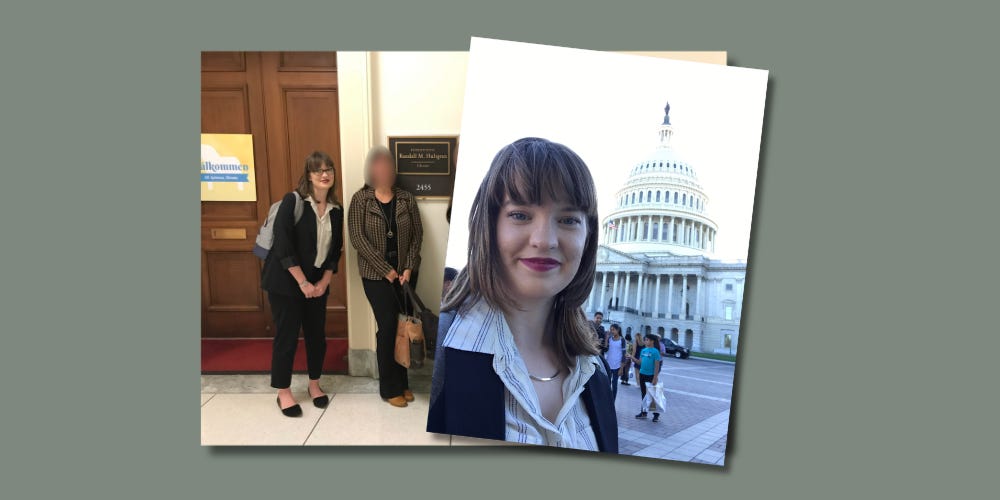
For several days we crisscrossed the Hill in our uncomfortable shoes, from the Russell or Dirksen buildings to Longworth or Rayburn and back, much as I had crisscrossed college campuses years earlier. I wasn’t quite as spry as I had been then, my feet now aching in narrow black flats and my tote bag digging into the knots in my shoulders. We hoped to catch Members of Congress in between meals and votes and committee meetings so we could explain to them why a group of evangelical Christians cared about preserving the refugee resettlement program. Our talking points were concise, the staffers professional. We used at least as many Bible verses out of context as I had in my high school apologetics speeches.
I don’t recall now if any tangible change came from our efforts, but I do remember feeling accomplished, important. I felt the way you might at the end of a strenuous session at the gym, riding the high of exertion and the certainty that we were one hour closer to our goals. But our running was more the treadmill variety than cross country. We were working so hard to go almost nowhere. During that season I blogged about refugees and immigrants, I interviewed our organization’s clients to write fundraising appeals, I planned fundraising galas, I worked on position paper after position paper for my Master’s degree, and I attended protests against family separation at the border.
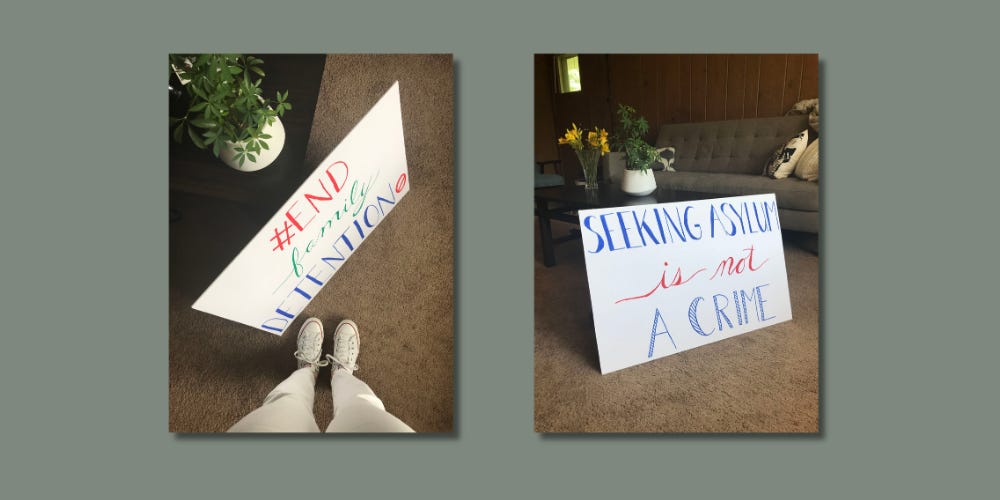
I had traded missionary biographies and speech and debate tournaments for social activism and online advocacy, sure that if I couldn’t change the world for Jesus, maybe I could at least change America. I had begun to distance myself from fundamentalism, and yet I could not escape the fundamental belief that the only way to prove my principles—whatever they might be now—was by doing something big. I had never laid down the weapons I once wielded in the culture wars—I had only switched sides. I didn’t just need to reconsider the shape I thought the world should take, but the very belief that I had been called to fill the role of World Shaper.
Our View of the World
James Davison Hunter coined the term “culture wars” in 1991 when he published a book by the same name.5 In it, he described a growing division in America over the fundamental identity of the country. While these culture wars were being fought over key institutions like law, education, and the family, the divisions ran far deeper than political parties or even religious identities to our understanding of truth and meaning itself. You don’t have to look very far to see the destructive ways these culture wars continue today, with Christians some of the most vocal warriors on either end of the bloody battleground. This is because the vast majority of Christians, regardless of their political persuasions, still operate within a framework of culture change that Hunter calls the worldview approach.
In his 2010 book To Change the World, Hunter addresses this common view of culture and cultural change. He summarizes it this way.
“The essence of culture is found in the hearts and minds of individuals—in what are typically called “values.” Values are, simply, moral preferences; inclinations toward or conscious attachment to what is good and right and true. Culture is manifested in the ways these values guide actual decisions we individuals make about how to live—that is, how we spend our time; how we work; how we play; whom we marry, and how and why; how we raise our children; whom or what we worship; and so on. By this view, a culture is made up of the accumulation of values held by the majority of people and the choices made on the basis of those values.” (pg. 6)
Hunter identifies three “tactics” most frequently employed by those seeking to change the world based on this understanding of culture: evangelism (most often in the form of apologetics), political action, and social reform. The challenge, though, that we see so obviously in American culture today is that we have primarily two groups of Christians who interpret Scripture quite differently and who are both seeking to change culture by these means. Hunter quotes James Dobson of Focus on the Family as saying,
“The side that wins gains the right to teach what it believes to its children. And if you do that, you write the curricula, you tell them what to believe and you model what you want them to understand and in one generation, you change the whole culture.” (pg. 13)
While growing up I often heard culture referred to as “a marketplace of ideas”, one in which a biblical worldview had been shunted to the clearance rack in the back of the store. Our task as the Joshua generation was to return it to prime retail real estate, to a prominent endcap where it could be marketed as the superior product that it was. And yet, here I was, as a young adult, discovering that not all who claim the name of Christ agree on what is “biblical”, and realizing that even my own understandings and opinions and convictions seemed to be constantly changing.
What then are Christians to do? At the risk of breaking the metaphor, are we all to stand in the aisles of the idea marketplace bickering over which products to stock and where to display them? No wonder we feel so tired. Hunter reveals the truth that I wasn’t willing to face until the undertow of exhaustion threatened to take me under: I hadn’t divested from the culture wars; I had just traded one suit of suffocating armor for another. Exposed to different interpretations of Scripture, a wider view of the world and the types of suffering that filled it, and the jarring hypocrisies of the faith that raised me, I had begun to deepen my understanding of the word “biblical.” I was beginning to reconsider what actually belonged on that endcap in the marketplace of ideas, but it had never occurred to me what freedom might lie beyond the walls of the store.
I was, without a doubt, growing and maturing in my grasp of faith and the way I lived it, but I had continued to center myself in the story, slipping back into the hero’s costume, discontent to be a beloved extra in the drama God was sovereignly unfolding. It would be several more years before I was ready to admit defeat and lay down my banner for world change. In the form of beautiful irony that God’s sovereignty sometimes takes, it would be a missionary biography that would prompt the question that would finally begin to crack everything open, and a host of chronic illnesses provoked by a tragedy during a short-term mission trip that would transform daily faithfulness from something boring and ordinary into something truly extraordinary.
I’m serializing my debut nonfiction book on Substack—for FREE. Subscribe so you don’t miss the next chapter.
How are you engaged in the culture wars today in ways you might not have realized? Do you find that engagement fruitful or draining?
They desired more local control and “limited central government”, as modeled by America’s own founding fathers.
Interestingly, Barack Obama started an outreach campaign to young evangelical voters by an almost identical name (Joshua Generation) in 2008. HSLDA took legal action for trademark infringement.
In the early 2000’s I participated in a GenJ election simulation at a large homeschool convention. Hundreds of homeschool youth filled a convention center ballroom and worked together to write political party position statements, organize caucuses, and eventually work through an entire mock election. I don’t recall now, but I don’t imagine the pretend political parties we devised held very diverse positions.
Michael Farris also founded Patrick Henry College in 2000, a Christian liberal arts institution with a focus on majors like government, journalism, economics and business analytics, classics and philosophy. According to their website, their values include “high academic rigor,” “fidelity to the spirit of the American founding,” and an “unwavering biblical worldview.”
This post contains affiliate links. That just means that if you purchase a book through one of these links, I get a few pennies for my own book buying habit.
It's a good challenge to meditate on Hunter's thoughts on what makes up culture. One thing that comes to mind is the huge difference between creating and warring - I have the image of a fragile piece of ceramic art or stained glass, dashed to pieces in a melée or shattered by a bomb. Art and war do not easily coexist. When a community holds "changing the world" as a core value--can we call a method a value? I don't know if that is correct, but it seems that method becomes a central part of fundamentalism: we believe this, this, and this and in this way of doing things - please read as though "this" is emphasized by italics--I say again, when a community holds "changing the world" (specifically by debate/argument, force, etc) as a core value, their core values central to everyone else's thinking, the "culture" that flows out of that is a culture of war itself. In war, there is no curiosity. Soldiers don't ask questions - aren't allowed to ask questions - they take commands. There is no winsome approach to discern what might be called "good" by the Creator in every human culture on this earth (after all, Genesis 1:28, right?). Thank you for the way you are spooling out this excellent meditation, Tabitha. I'm a big fan.
I enjoy seeing the connections you make and find that you give me plenty to ponder. To answer your question, I have engaged with culture in various ways and think that the framing and motivation are hugely impactful to that experience. If I am trying to wear the cape or fix everything, it is exhausting. But fruitfulness is possible.